How comes ads with utility messaging works 18% better if people are mentally busy. But, an emotional, experiential ad works better if audience is in a relaxed mental state? And what does that mean for media planning and marketing effectiveness?
Which ad performs better and why?
Imagine your creative agency presents two types of ads. The first is straightforward and informational: key features listed clearly, a headline promising "30% more free time," clean visuals that communicate functionality at a glance. The second is emotional and aspirational: two young professionals contrasted – one overwhelmed and stressed, the other using your app, enjoying brunch with friends, living the balanced life everyone wants. Which works better? The honest answer: it depends entirely on when and where people see it.
Researchers Wang et.al. (2024) at Nankai University analyzed over 570,000 mobile ads and discovered that audience mental state fundamentally changes which advertising works best.
Ad analysis examined 572,507 ad views from 1,177 mobile ads on an Asian social media platform. They tracked click-through rates against contextual variables indicating user busyness (time of day, day of week, platform section). Ads with functional, utility messaging performed better when contextual indicators suggested user busyness. Ads with emotional, experiential messaging performed better when indicators suggested relaxed browsing. The pattern held across this massive natural dataset.
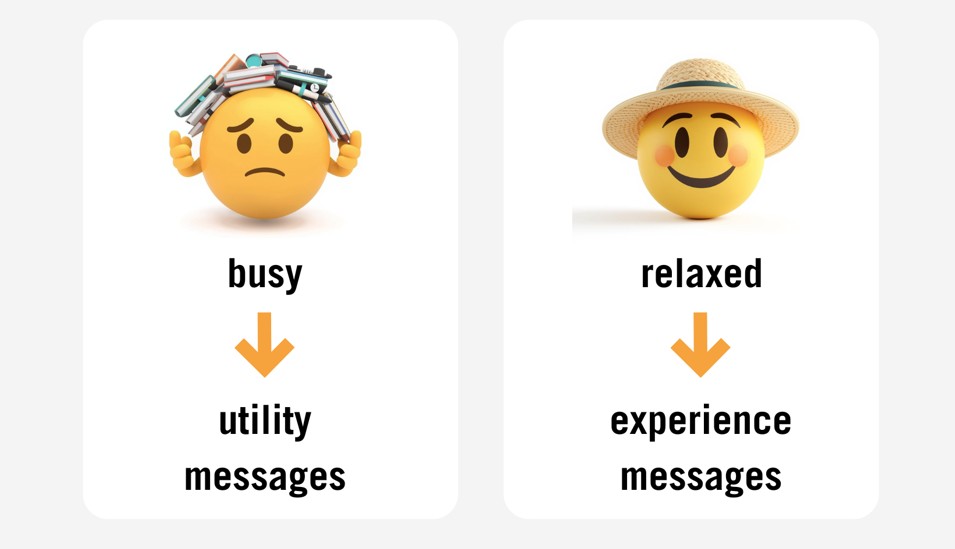
In a controlled experiment they manipulated both busyness and ad type. Participants in busy conditions (given multiple tasks to juggle) and relaxed conditions (given leisure time) saw either rational ads emphasizing sound quality or emotional ads emphasizing listening enjoyment. Busy participants liked headphones 18.1% more when shown rational appeals. Relaxed participants liked headphones 7.1% more when shown emotional appeals. The interaction was significant: degree of busyness had a significant impact on ad appeal.
Busy people – those juggling tasks, racing deadlines, scrolling quickly between meetings – responded better to informational ads highlighting features and benefits. Relaxed people – those leisurely browsing on weekends, watching entertainment content, shopping without time pressure – responded better to emotional ads emphasizing experiences and feelings.
The finding adds a critical variable to media planning: audience’s mental state. The same creative that succeeds when viewers have cognitive bandwidth may fail when they're rushed—and vice versa. Strategic advertising requires matching message type to the psychological context of consumption.
The Reason behind: Goal Processing Shift
The psychology underlying the busyness effect involves how cognitive load shapes what information we attend to and what we seek from our environment. Busyness creates resource scarcity. When we're busy – managing multiple demands, operating under time pressure, dividing attention across tasks – cognitive resources become precious. We can't process everything that competes for our attention, so we become selective. We focus on what's essential and filter out what isn't directly useful for our immediate goals.
Research on goal pursuit shows that when mental resources are constrained, we become more outcome-oriented. We care about whether something helps us achieve what we need to achieve. Busy people process information through a filter of "Will this help me accomplish my goals?"
Outcome orientation increases preference for functionality information. When people evaluate products in an outcome-focused state, they naturally gravitate toward features and benefits – the practical attributes that determine whether the product achieves its purpose. Sound quality matters because it affects whether headphones do their job. Time savings matter because they represent concrete goal progress.
Relaxation creates resource abundance. When we're not busy – enjoying leisure time, browsing without agenda, consuming entertainment – cognitive resources are plentiful. We can afford to process information that doesn't directly serve immediate goals. We can appreciate experiences, explore emotions, and engage with content for its own sake. Relaxed viewers engage with emotional appeals because they have the bandwidth to do so and because process-oriented mindsets value experiential qualities. The joy of using headphones resonate when cognitive space exists to appreciate them.
What This Means For Your Marketing
The research provides guidance for matching creative strategy to audience mental states through contextual advertising.
For media planning, map your placements to expected audience busyness states. Busy context favor rational messaging. Relaxed context favor emotional messaging.
For creative versioning, develop both rational and emotional variants of campaigns. Deploy rational versions in high-busyness contexts; deploy emotional versions in low-busyness contexts. The same product can succeed with both approaches when matched to appropriate mental states.
For video pre-rolls, match message type to content type. Pre-rolls before business content should lean rational. Pre-rolls before entertainment content should lean emotional. The viewing context signals audience mental state.
For podcast advertising, recognize that podcast contexts vary. Podcasts consumed during commutes or workouts (busy multitasking) may favor rational appeals. Podcasts consumed during leisure time (relaxed attention) may favor emotional appeals. Genre and listening occasion matter.
For billboard and outdoor, favor rational messaging with clear benefits. Outdoor is predominantly seen by busy people in transit—cognitive bandwidth is limited, viewing time is short. Functional information that registers quickly serves this context better than emotional complexity.
For television advertising, favor emotional storytelling. TV viewing typically occurs during leisure time when audiences have bandwidth for emotional engagement. The medium suits emotional appeals that would be filtered out in busier contexts.
For retail and point-of-sale, assess shopper states. Time-pressured shoppers grabbing essentials respond to clear functional claims. Leisurely browsers respond to experiential messaging. Store sections and shopping occasions vary in typical busyness levels.
Sources
Wang, X., Han, X., Wu, Z., Du, J., & Zhu, L. (2025). The busier, the more outcome-oriented? How perceived busyness shapes preference for advertising appeals. Journal of Retailing and Consumer Services, 82, 104172. https://doi.org/10.1016/j.jretconser.2024.104172
Bhattacharjee, A., & Mogilner, C. (2014). Happiness from ordinary and extraordinary experiences. Journal of Consumer Research, 41(1), 1-17. https://doi.org/10.1086/674724
Kivetz, R., & Zheng, Y. (2017). The effects of promotions on hedonic versus utilitarian purchases. Journal of Consumer Psychology, 27(1), 59-68. https://doi.org/10.1016/j.jcps.2016.05.005
Pham, M. T. (1998). Representativeness, relevance, and the use of feelings in decision making. Journal of Consumer Research, 25(2), 144-159. https://doi.org/10.1086/209532
Rucker, D. D., & Petty, R. E. (2006). Increasing the effectiveness of communications to consumers: Recommendations based on elaboration likelihood and attitude certainty perspectives. Journal of Public Policy & Marketing, 25(1), 39-52. https